Four-Channel 1080p Stitching to 4K Output: A Bandwidth Ledger
Stitching four 1080p camera feeds into one 4K output looks like “just putting four pictures together,” but behind it lies a bandwidth ledger: input bandwidth, DDR frame-buffer bandwidth, scaling engine bandwidth, and output bandwidth — four layers stacked on top of each other. Get the math wrong and you get stuttering, tearing, or DDR overload. This article walks through every layer from pixel clock upward.
1. Input Bandwidth: How Much Data Is Four 1080p60 Feeds?
Four 1080p60 cameras, each in 8-bit RGB:
| Item | Formula | Result |
|---|---|---|
| Pixels per channel | 1920 × 1080 | 2,073,600 pixels/frame |
| Frame rate | 60 fps | — |
| Per-channel data rate (8-bit RGB) | 1920 × 1080 × 3 × 8 × 60 | ≈ 2.99 Gb/s ≈ 374 MB/s |
| Four-channel total input | 2.99 Gb/s × 4 | ≈ 11.96 Gb/s ≈ 1.5 GB/s |
If using YCbCr 4:2:2 (common for industrial cameras), 16 bits per pixel:
1920 × 1080 × 16bit × 60fps ≈ 1.99 Gb/s ≈ 249 MB/s; four channels ≈ 7.97 Gb/s ≈ 996 MB/s.
This input figure determines how many GTP/GTX transceivers and HDMI decoder chips the FPGA receiver needs.
2. DDR Frame Buffer: Read + Write = Double the Bandwidth
Four video feeds must be buffered to DDR before stitching. The four inputs are asynchronous, and the 4K60 output runs on a unified clock — DDR is the cross-clock-domain buffer.
How much DDR the frame buffers occupy
Four 1080p channels, double-buffered (2 frames each to avoid tearing):
| Item | Calculation | Result |
|---|---|---|
| Single frame size (1080p60 8-bit RGB) | 1920 × 1080 × 3 bytes | ≈ 6.2 MB |
| Four channels × double buffer | 6.2 MB × 4 × 2 | ≈ 49.6 MB |
| 4K output frame buffer (3840×2160) | 3840 × 2160 × 3 bytes | ≈ 24.9 MB |
| Total DDR footprint | — | ≈ 75 MB |
DDR bandwidth budget: read + write doubles it
The data flow: four inputs → DDR write (store frames) → scaling engine reads → DDR read (fetch frames) → stitch → output.
Per second, DDR must handle:
| Direction | Data/sec | Notes |
|---|---|---|
| DDR write (four inputs) | ≈ 1.5 GB/s | Four 1080p frames written |
| DDR read (scaling fetch) | ≈ 1.5 GB/s | Four frames read for scaling |
| DDR write (stitched 4K) | ≈ 1.5 GB/s | 4K60 frame written to output buffer |
| DDR read (4K output) | ≈ 1.5 GB/s | 4K60 frame read for HDMI |
| Total DDR bandwidth needed | ≈ 6 GB/s | Read+write combined |
3. Output Bandwidth: How Big Is 4K60?
The stitched output is 3840×2160@60Hz, 8-bit RGB:
| Item | Formula | Result |
|---|---|---|
| 4K60 data rate | 3840 × 2160 × 3 × 8 × 60 | ≈ 11.94 Gb/s ≈ 1.49 GB/s |
| HDMI 2.0 bandwidth | — | 18 Gb/s (sufficient) |
| DP 1.2 bandwidth | — | ≈ 17.3 Gb/s (just enough) |
4K60 output itself is 12 Gb/s; both HDMI 2.0 and DP 1.2 can carry it. But note: the output clock and DDR read clock are asynchronous — a FIFO is needed for clock-domain crossing.
4. The Full Chain Bandwidth Ledger
| Stage | Bandwidth | Device |
|---|---|---|
| Four 1080p input | ≈ 1.5 GB/s | HDMI decoder + FMC/parallel IO |
| DDR write (input buffer) | ≈ 1.5 GB/s | DDR controller |
| DDR read (scaling fetch) | ≈ 1.5 GB/s | DDR controller |
| Scaling engine | ≈ 1.5 GB/s | DSP / logic |
| DDR write (4K frame buffer) | ≈ 1.5 GB/s | DDR controller |
| DDR read (4K output) | ≈ 1.5 GB/s | DDR controller |
| 4K60 HDMI output | ≈ 1.5 GB/s | HDMI 2.0 TX |
| DDR peak total | ≈ 6 GB/s | — |
Why DDR is the bottleneck
DDR bandwidth of Duyuan’s common boards:
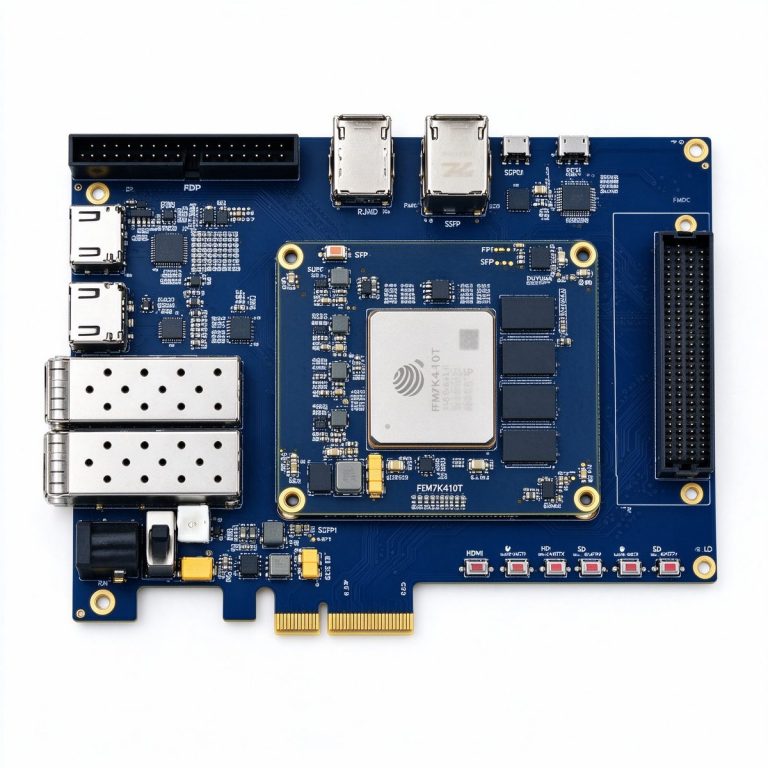
- DUK7410T (4GB DDR3 64-bit 1866Mbps): ≈ 14.9 GB/s — plenty for 6 GB/s
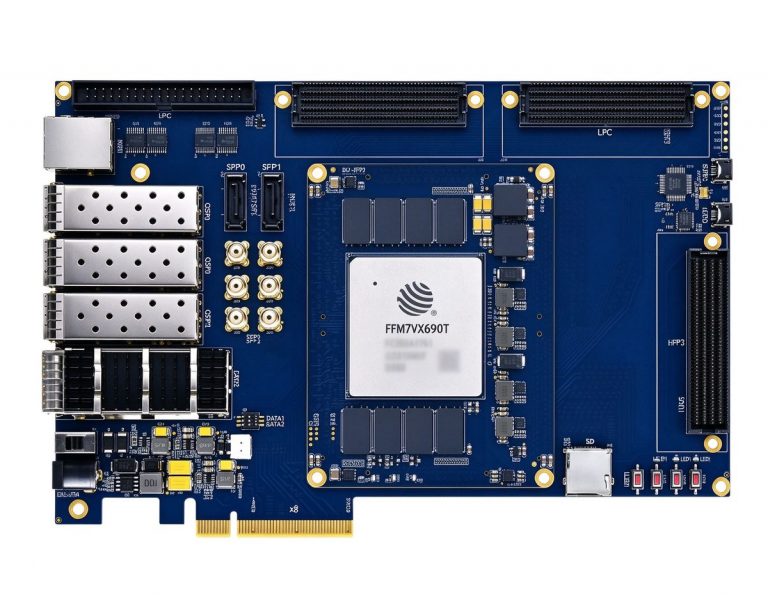
- DUF7690T (4GB DDR3 64-bit 1866Mbps): ≈ 14.9 GB/s — same
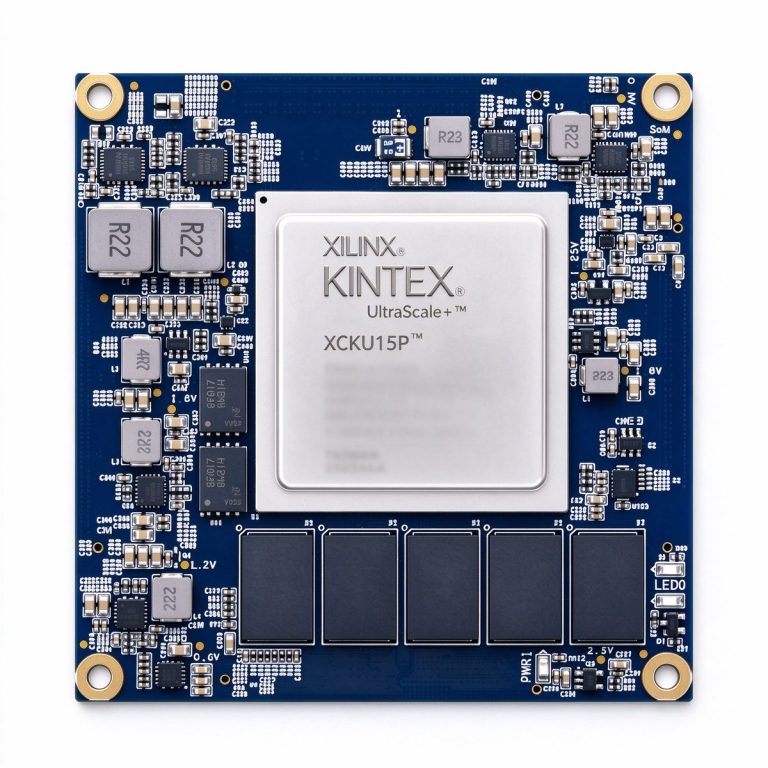
- XCKU15P (8GB DDR4 ECC 64-bit 2400Mbps): ≈ 19.2 GB/s — more headroom for multi-channel 4K
Four-channel 1080p stitching to 4K works on DDR3. But for eight 1080p channels or two 4K inputs, DDR4 is required.
5. Which Board to Choose
DUK7410T (¥9,999) — Entry-level four-channel stitching
FMSH JFM7K410T. Logic resources are sufficient, DDR3 bandwidth of 14.9 GB/s gives ample margin for four-channel stitching. Pair with an FMC HPC card for four HDMI inputs, use onboard HDMI output for 4K display. Ideal for small 2×2 video walls and industrial monitoring.
DUF7690T (¥24,999) — Multi-channel stitching workhorse
FMSH JFM7VX690T. Several times more logic and DSP, handling more complex scaling filters and color correction. Onboard QSFP 40G can transmit the stitched 4K stream over fiber to a remote display. Suited for multi-screen stitching + fiber backhaul.
XCKU15P (¥15,999) — High-bandwidth 4K overlay
AMD Kintex UltraScale+ XCKU15P. DDR4 ECC bandwidth 19.2 GB/s, paired with UltraScale+ transceivers. Suited for eight-channel 1080p stitching or dual 4K input overlay. Choose this if you plan to scale to 8 channels or multi 4K60 inputs.
Four-channel stitching is not hard — the hard part is getting every channel’s bandwidth right. DDR is the most underestimated bottleneck in stitching systems: 1.5 GB/s input looks small, but doubled read+write it becomes 6 GB/s. Do the math before picking a board.
>
— Duyuan Engineering Team