How to Choose a China FPGA: Pango vs FMSH vs Anlogic — 2026 Mid-Range Comparison
Over the past three years, “domestic substitution” in the FPGA industry has gone from a slogan to real orders. But when it comes to selection, engineers often get stuck: among the three major Chinese FPGA vendors, which mid-range device should you pick? This article gives a 2026 horizontal comparison.
Over the past three years, “domestic substitution” in the FPGA industry has gone from a slogan to real orders. Communication equipment makers must complete key board-level localization by 2027; industrial control, power, rail transit, and medical imaging tenders now treat “fully domestic BOM” as a hard requirement rather than a bonus; drones, robotics, and edge AI are also actively evaluating Chinese FPGAs.
But when it comes to actual selection, hardware engineers often hit the same wall: among the major Chinese FPGA vendors — Pango (紫光同创), FMSH (复旦微), and Anlogic (安路科技) — how do their product lines differ? Which one should you choose for the mid-range segment (100K–500K LUT, with Gigabit/10 Gigabit SerDes)? Based on public materials and Duyuan’s real project evaluation experience, this article provides a 2026 horizontal comparison of mid-range Chinese FPGAs.
Note: This article focuses on the “mid-range, industrial-grade, mass-production available” segment (roughly 50K–500K LUT, with SerDes, industrial temperature range). Ultra-large devices (FMSH JFM9, Pango PG3T1300/1500) and small low-power parts (Anlogic ELF, Pango Logos entry) are only briefly covered in the comparison tables.
1. At a Glance: Positioning of the Three Vendors
First, where each vendor sits in the Chinese FPGA landscape:
Table: Three Chinese FPGA vendors at a glance (2026 public data)
| Dimension | Pango | FMSH (Fudan Micro) | Anlogic |
|---|---|---|---|
| HQ / Background | Shenzhen, under Tsinghua Unigroup | Shanghai, CAS-backed, A+H listed | Shanghai Zhangjiang, STAR Market (688107) |
| Product generations | Logos (low) / Titan-2 (mid) / Titan-3 (high) / Kosmo SoPC | FMK/JFM industrial + space-grade; PSoC (FMQL); FPAI AI chip | ELF (low-power) / EAGLE (mid) / PHOENIX (high) / DRAGON (in development) |
| Process node | Titan-3 on FinFET | 28nm mainstream; new large parts use 2.5D packaging | Mainly 28nm / 55nm |
| High-end flagship | PG3T1300 / PG3T1500 (hundred-million-gate) | JFM9 (542K–3780K logic, billion-gate) | PHOENIX 1A (60–400K LUT) |
| Differentiator | Communication / network equipment mainstay | Space / radiation-hardened, metering / industrial reliability | Low power, consumer / industrial display, cost-sensitive |
| MPSoC heterogeneous | Kosmo PG2K100 (dual-core A53) | FMQL series (ARM+FPGA, Zynq-compatible); FPAI (8-core + NPU + FPGA) | Some ELF models embed Cortex-M3 |
In one sentence: Pango leads in communication and high-end general-purpose FPGAs, FMSH in high-reliability / space-grade and industrial applications, and Anlogic in low-power, low-cost consumer and industrial display markets. Their mid-range products overlap, but target customers are not entirely the same.
2. Pango: Titan-3 Pushed Chinese FPGAs to a New Level
2.1 Product Matrix
- Logos series: PGL12G / PGL22G / PGL50G, 10K–43K LUT, SerDes up to 6.375 Gbps — cost-effective control and interface expansion;
- Titan-2 series: PG2T70H / PG2T160H / PG2T390H, 42K–243K LUT, 6.6–12.5 Gbps SerDes — workhorse for industrial and communication;
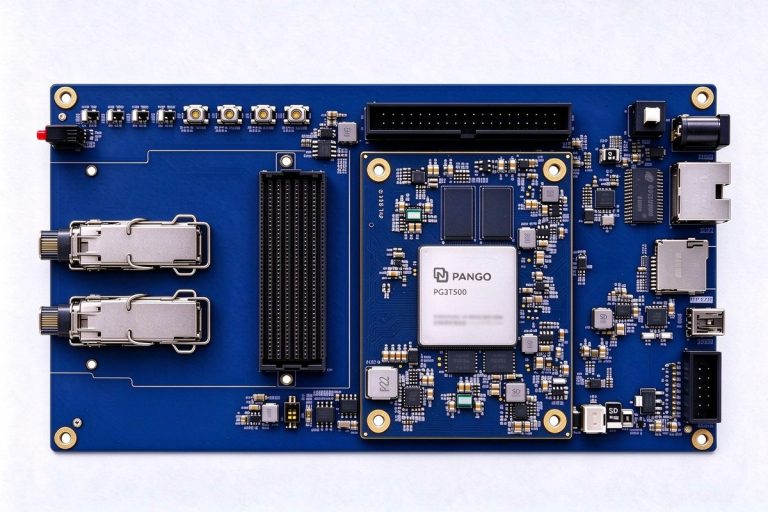
- Titan-3 series: flagship PG3T500 (500K logic cells, 242,176 LUT6), integrates PCIe Gen4 x8 hard block, supports DDR4-2800, high-speed SerDes — China’s first mass-produced FinFET FPGA; higher PG3T1300/1500 target communication and data center;
- Kosmo SoPC: PG2K100, dual-core 64-bit A53, for industrial control, video, and edge AI.
2.2 Strengths
What impresses about Pango in recent years is the “high-end breakthrough.” The PG3T500 brings Chinese FPGAs for the first time to PCIe Gen4 x8 + FinFET, with 500K logic cells — roughly the level of Xilinx Kintex UltraScale+ mid-range (XCKU9P/KU15P). The Titan-3 family is already shipping in communication, medical, and test/measurement applications; the PG3T500 won the 20th “China Core” Outstanding Technology Innovation Product award. For customers replacing Kintex-7/US+ in communication and industrial designs, this is the most direct match.
2.3 Weaknesses
First, lead times for high-end devices remain long, constrained by FinFET foundry capacity. Second, the PDS toolchain still lags Vivado in timing closure efficiency and IP richness; complex designs iterate more slowly. Third, entry-level Logos only reaches 6.375G SerDes — for 10G+ interfaces you must step up to Titan.
3. FMSH: From Smart Meters to Space — The Strongest High-Reliability Label
3.1 Product Matrix
- FM7/FMK industrial series: FMK300T16, 320K-class logic, 840 DSPs, 445 BRAM blocks, PCIe hard block — network communication acceleration;
- JFM9 ultra-large series: 542K–3780K programmable logic (billion-gate), some models use 2.5D advanced packaging — same-power clock doubled vs JFM7, or same-clock power down 40%; new high-end parts reach 947K logic, 432K LUT6, 4296 DSP, 1104×36Kb BRAM + 256×288Kb UltraRAM;
- PSoC (FMQL series): ARM + FPGA heterogeneous, architecturally compatible with Zynq-7045/7100 — the most mature domestic Zynq replacement path;
- FPAI AI chip: single-chip 8-core processor + Wolong NPU + large FPGA, public peak 128 TOPS INT8;
- Space-grade line: JFM7/JFM9 radiation-hardened FPGAs, PSoC, dedicated scrubbing chips, fully domestic EDA flow — covering commercial space and satellite communications.
3.2 Strengths
FMSH’s differentiation is clear: high reliability, space-grade, fully domestic EDA. For applications with hard requirements on temperature, radiation tolerance, and long supply (power protection, rail transit, commercial space, high-reliability electronics), FMSH has the most complete qualification among the three. The FMQL series as Zynq-compatible MPSoC provides the most direct migration path for teams needing heterogeneous SoC domestic substitution.
3.3 Weaknesses
General-purpose industrial/communication FPGAs are slightly less cost-effective and less ecosystem-mature than Pango in commercial markets; consumer and low-cost scenarios are not their main track; the newest high-end parts look great on paper, but mass-production cases and third-party board ecosystems are still maturing.
4. Anlogic: Low-Power and Cost-Sensitive Pick
4.1 Product Matrix
- ELF series: 55nm low-power, 1.5K–11.7K LUT, smallest package 4.2×4.2 mm, embedded Flash for fast boot, some models with hard Cortex-M3 — IoT, industrial display, consumer;
- EAGLE series: EG4 etc., low power, low cost, high value — industrial control, display driving, communication access;
- PHOENIX 1A series: 60K–400K LUT, SerDes up to 12.5 Gbps, PCIe Gen1/2/3 x1/x2/x4, DDR3/DDR4-1866, 2.5Gbps MIPI, SEU detection/correction;
- DRAGON series: in development for automotive and edge computing.
4.2 Strengths
Anlogic’s core label is low power + cost + fast time-to-market. ELF with embedded Flash, single supply, tiny package is optimal for interface expansion, bridging, and display driving. PHOENIX at mid-range (60–180K LUT) packs SerDes, PCIe, and DDR4, priced more competitively than equivalent Pango/FMSH parts. Automotive (AEC-Q100), HDMI low-latency, DR1 block encoding already have production cases.
4.3 Weaknesses
Ultra-large FPGAs still catching up (PHOENIX max 400K LUT, not in the same league as Titan-3 or JFM9); 100G+ optical and PCIe Gen4 hard blocks are absent for now; the TD toolchain and IP library are the most in need of improvement among the three.
5. Mid-Range (60K–500K LUT) Horizontal Comparison
Table: Key parameters of the three mainstream mid-range models (source: vendor product pages, 2026-09)
| Item | Pango PG3T500 (Titan-3) | FMSH FMK300T16 (FM7) | Anlogic PHOENIX 1A high-end |
|---|---|---|---|
| LUT size | 242,176 LUT6 (~500K logic cells) | 326,080 logic cells | 60K–400K LUT |
| DSP | On-chip DSP (APM 1804) | 840 | Rich (M18×18) |
| BRAM / on-chip memory | DRM 616×36Kb + HRM 68×288Kb | 445 BRAM blocks, 15.64 Mb total | eRAM in multiple configs |
| High-speed SerDes | 16 MGT, PCIe Gen4 x8 hard block | 16 high-speed channels | Up to 12.5 Gbps, PCIe Gen3 x4 |
| Memory interface | DDR4-2800 (DDR5 ready) | DDR3/DDR4 | DDR3/DDR4-1866 |
| Process | FinFET advanced | 28nm | 28nm (ELF 55nm) |
| Typical markets | Communication equipment, medical, test & measurement, data acquisition | Industrial comm acceleration, high reliability, space | Industrial display, video interfaces, cost-sensitive industrial |
| MPSoC companion | Kosmo PG2K100 (dual A53) | FMQL (Zynq-compatible), FPAI (NPU) | Some ELF with Cortex-M3 |
| Toolchain | PDS (continuously iterated, Vivado-like design flow) | Fully self-developed domestic EDA | TD (easy to start, IP library growing) |
6. How to Choose by Scenario
6.1 Communication / Network Equipment (routers, switches, transport, RRU)
Prefer Pango Titan-3. The PG3T500’s PCIe Gen4 x8 hard block, 16 MGT, and FinFET process is currently the best match for communication equipment requirements; Pango has the most mature customer cases and reference designs in this industry. For Zynq-compatible control plane, FMSH FMQL is the alternative.
6.2 Industrial High-Reliability + FPGA/ARM Heterogeneous (power, rail, medical, industrial gateways)
Prefer FMSH. FMK has enough resources for industrial comm acceleration, and FMSH has the strongest qualifications in high reliability, long supply, and fully domestic EDA. For “FPGA + ARM Linux” heterogeneous, FMQL series (matching Zynq-7045/7100) is the most mature domestic MPSoC choice; Pango Kosmo PG2K100 (dual A53) is a supplement. Duyuan offers standard boards on both FMQL and ZU+ platforms.
6.3 Video / Display / Low-Power Interfaces (industrial display, video capture, consumer bridging)
Prefer Anlogic PHOENIX / EAGLE / ELF. PHOENIX 1A with 12.5G SerDes + PCIe Gen3 handles 4K video and high-speed interfaces, with friendlier cost and power. ELF 55nm, embedded Flash, single supply, 4.2×4.2 mm package minimizes BOM cost and peripheral count for interface expansion, bridging, and board management.
6.4 Commercial Space / Extreme Environments (airborne, missile, satellite payloads)
Go directly for FMSH JFM space-grade series. This is the most complete radiation-hardened line among Chinese FPGAs, with companion PSoC, dedicated scrubbing chips, and fully domestic EDA. Pango and Anlogic currently have no equivalent product in this segment.
7. Duyuan’s Recommendation: Don’t Think in Either/Or
In real projects, Duyuan often sees not “choose A or B” but “how to combine three domestic chips on one board.” A typical fully domestic industrial gateway design might be:
- Main control / protocol processing: FMSH FMQL (Zynq-compatible MPSoC) running Linux and business logic;
- High-speed interface / data preprocessing: Pango PG3T500 for SFP+ aggregation and DMA bridging;
- Low-speed I/O expansion / power management: Anlogic ELF small-logic for interface bridging and on-board management.
The benefit: each chip is used where it is strongest, avoiding overpaying for high-end performance where it is unnecessary, and avoiding underpowered parts for high-speed interfaces. Duyuan currently offers standard boards or customizable SoMs on Pango Titan3 (DUPG3T500 platform), domestic Kintex-7 SoM (PBC7K325G), and FMSH FMQL platform — ready as a starting point for your evaluation.
8. Closing Thoughts
The 2026 China FPGA market has moved past “do they exist” into “how to choose.” Each vendor has its home turf: Pango pushed high-end Chinese FPGAs to PCIe Gen4 + FinFET, FMSH holds the high-reliability and space ground, Anlogic offers the best value in low-power and cost-sensitive scenarios. For hardware engineers, the pragmatic approach is not to bet on one vendor, but to layer by scenario, tier by price, and preserve replacement headroom — the principle Duyuan follows in domestic BOM design for customers.
References
- Pango website, Titan-3 / Titan-2 / Logos product series: https://www.pangomicro.com/
- Pango, PG3T500 mass production and Titan-3 launch news: https://pangomicro.com/about/news/company/22315.html
- FMSH website, FMK300T16 / JFM9 / FPAI product line: https://www.fmsh.com/fpga/
- FMSH, JFM9 billion-gate FPGA and 2026 new products: https://www.fmsh.com/
- Anlogic website, SALPHOENIX 1A / SALELF / SALEAGLE product pages: https://www.anlogic.com/product/fpga/phoenix
- EET-China, “FPGA market landscape adds new variables” (Chinese FPGA vendor comparison): https://www.eet-china.com/mp/a256581.html
Duyuan Electronics · Selection Guide | Data as of September 2026; vendor product pages are the authoritative source.