Fudan Micro JFM7 vs AMD/Xilinx 7-Series: Can China FPGA Truly Replace Them?
One of the most frequent questions Duyuan Electronics receives over the past two years is: “We used to use Xilinx XC7K325T, and now we need a China-based replacement. Can the Fudan Micro JFM7K325T be dropped in directly? How much code do we need to change? Do we need to redesign the PCB? How much performance do we lose?” This article puts three mainstream model pairs from the Fudan Micro JFM7 series and the AMD/Xilinx 7-series side by side, and explains exactly to what extent a “drop-in replacement” really holds.
1. What Is JFM7, Really: Not a New Design, But a Licensed China Version of the 7-Series
Let’s start with the background. The JFM7 series from Fudan Microelectronics is a China FPGA based on the Xilinx 7-series Kintex / Virtex architecture. It is not a brand-new architecture designed from scratch, but a China re-engineering and process migration of the 28nm Kintex-7 / Virtex-7 architecture, keeping logic cells, DSP, BRAM, GTX/GTH transceivers, PCIe hard blocks and configuration interfaces one-to-one with the original Xilinx parts.
This means two things:
- Toolchain compatibility: JFM7 can be synthesized, placed, routed and bitstream-generated with Xilinx Vivado. Project files can basically be migrated directly — no need to switch EDA tools
- Pin mapping: The BGA package, bank allocation and high-speed pin locations of JFM7K325T match XC7K325T, so an existing PCB design can achieve pin-to-pin replacement
These two points are the physical foundation on which “China replacement” stands. If swapping in a China FPGA meant learning a new EDA suite, redrawing the PCB and redoing signal integrity, that would not be a replacement — it would be building a new product. That is exactly where the value of JFM7 lies — all the design assets you accumulated on Kintex-7 can be reused.
2. Side-by-Side: Three Mainstream Model Pairs
The three China development boards currently offered by Duyuan Electronics correspond exactly to the three most commonly used chips in the AMD/Xilinx 7-series. The parameter comparison is as follows:
| Parameter | JFM7K325T / XC7K325T | JFM7K410T / XC7K410T | JFM7VX690T / XC7VX690T |
|---|---|---|---|
| Positioning | Mid-range Kintex-7 | High-end Kintex-7 | Flagship Virtex-7 |
| Process Node | 28nm (same) | 28nm (same) | 28nm (same) |
| Logic Cells (LC) | 326K | 406K | 693K |
| LUTs | 50,950 | 63,550 | 108,300 |
| DSP Slices | 840 | 1,540 | 3,600 |
| Block RAM | 16 Mb | 28.6 Mb | 52.9 Mb |
| High-Speed Transceivers | 16 × GTX @ 6.6G | 16 × GTX @ 6.6G | 36 × GTH @ 12.5G |
| PCIe Hard Block | Gen2 x8 | Gen2 x8 | Gen2 x8 |
| Package | FCBGA900 | FFG1156 | FFG1761 |
| Toolchain | Vivado compatible | Vivado compatible | Vivado compatible |
| Temp. Grade | Industrial -40~85°C | Industrial -40~85°C | Industrial -40~85°C |
Looking at the table, the core resource parameters of the three pairs are exactly one-to-one: logic capacity, DSP count, BRAM size, transceiver count and PCIe hard-block version all match. This is not “roughly similar” — it is an architectural re-creation of the original parts.
3. The Real Differences Aren’t in the Spec Sheet — They’re in These Four Things
Identical spec sheets do not mean “no difference at all.” When doing a China replacement, the four things below are what you really need to care about:
Difference 1: Speed Grade and Maximum Frequency — JFM7 Usually Only Goes to -2, Not -3
The original Xilinx parts come in -1 / -2 / -3 speed grades, with -3 being the fastest. JFM7 currently offers the industrial -2 speed grade as the mainstream option. This means if your original design runs in the -3 bin with tight timing margin (for example, GTX pushed to the 10.3Gbps limit, or internal logic running above 350MHz), switching to JFM7 may require timing-convergence optimization. The vast majority of industrial applications run fine in the -2 grade; customers doing high-speed serial or high-frequency trading should evaluate this point carefully.
Difference 2: IO Voltage and Bank Compatibility — 3.3V Banks Available, HP Banks Need Checking
HP (High Performance) banks on Kintex-7 support only 1.8V/1.9V at most, while HD (High Density) banks support 2.5V/3.3V. The bank electrical characteristics of JFM7 stay consistent with Xilinx, but you should check the JFM7 datasheet bank by bank to confirm which banks are HP and which are HD. The Duyuan boards already configure the levels of commonly used banks with adjustable resistors, so users can switch between 1.8V / 2.5V / 3.3V through the bank voltage adjustment pins.
Difference 3: ADC (XADC) and Analog Blocks — Same Accuracy Grade, but Different Factory Calibration Data
The Xilinx 7-series integrates XADC (12-bit 1MSPS analog acquisition), and JFM7 keeps this block as well. Analog channel count, sample rate and resolution are identical. However, the factory calibration coefficients (offset / gain error) are written independently into each chip, so during migration you must re-read them from the JFM7’s EFUSE instead of reusing the calibration values of the original Xilinx chip. Customers doing precision measurement need to adapt this part of the software logic.
Difference 4: Package and Mechanical — BGA Ball Positions Match, but Recheck the Thermal Pad
The BGA package dimensions, ball pitch and pin arrangement of JFM7 match the original Xilinx parts, so PCB pads are interchangeable. However, the size of the exposed thermal pad (EP) at the center of the die and the thermal resistance θ_JA may differ slightly. If your original design uses a heatsink or forced air cooling, we recommend running a thermal simulation again. The Duyuan boards ship without a fan by default (natural convection plus a large copper pour); customers can add active cooling according to their power budget in volume production.
4. When You Must Choose China FPGA, and When to Stay with Xilinx
Now that the differences are clear, here is a straightforward selection recommendation.
Scenarios where JFM7 China FPGA is a must
- Xinchuang / high-reliability equipment / power / rail transit / medical device certification: a fully China supply chain is required, so JFM7 is the way to go
- Xilinx 7-series is out of stock or lead time > 52 weeks: since 2024 the 7-series has repeatedly suffered shortages and price hikes on the international market; JFM7 is a stable supply path
- Long-lifecycle products (10–15 years): the Xilinx 7-series is already in its EOL countdown; JFM7 is the China-based path to keep products alive
- Cost-sensitive volume products: the full-board JFM7 solution has a clear price advantage over the original Xilinx parts
Scenarios where you should stay with Xilinx
- Already running at -3 speed-grade limits: JFM7 currently tops out at -2, so timing will be tight
- Using Xilinx proprietary IP (e.g. JESD204 hard block, Aurora 64B/66B paid IP): you need to confirm JFM7’s licensing and compatibility for these IPs
- Overseas sales with no China-compliance requirement: without a compliance mandate, the Xilinx ecosystem is still more mature
- Prototyping phase with rapid iteration: validate with the Xilinx toolchain first, then migrate to JFM7 once the design is frozen
5. How to Choose Among Duyuan’s Three China Boards
Duyuan Electronics builds three tiers of development boards on the JFM7 series, covering the full range from industrial volume to high-end China-based design:
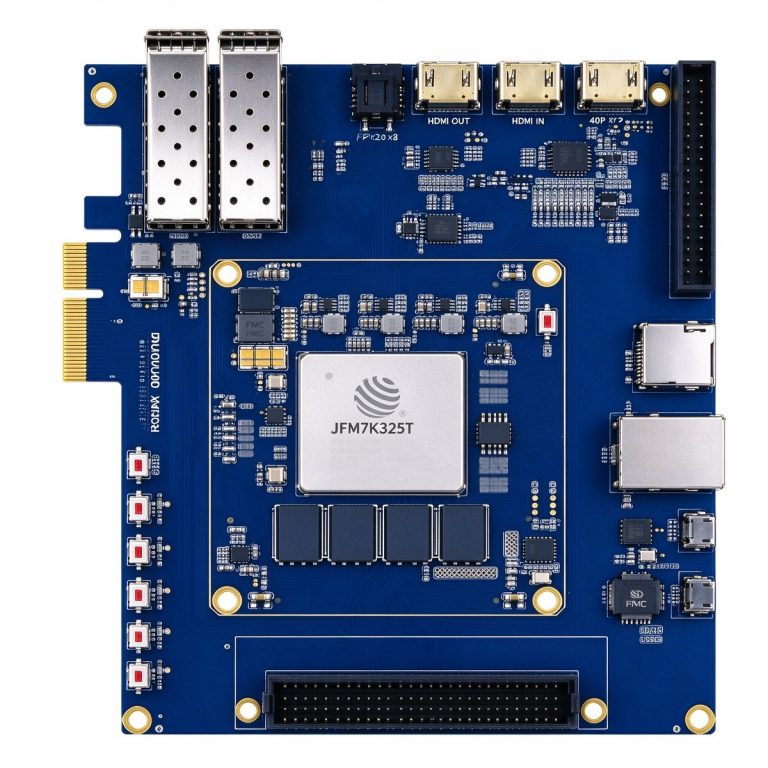
- DUK7325T V1.0 ($1,231): JFM7K325T, 326K LC / 840 DSP / 16 GTX — the cost-effective pick for industrial control, protocol conversion and video processing
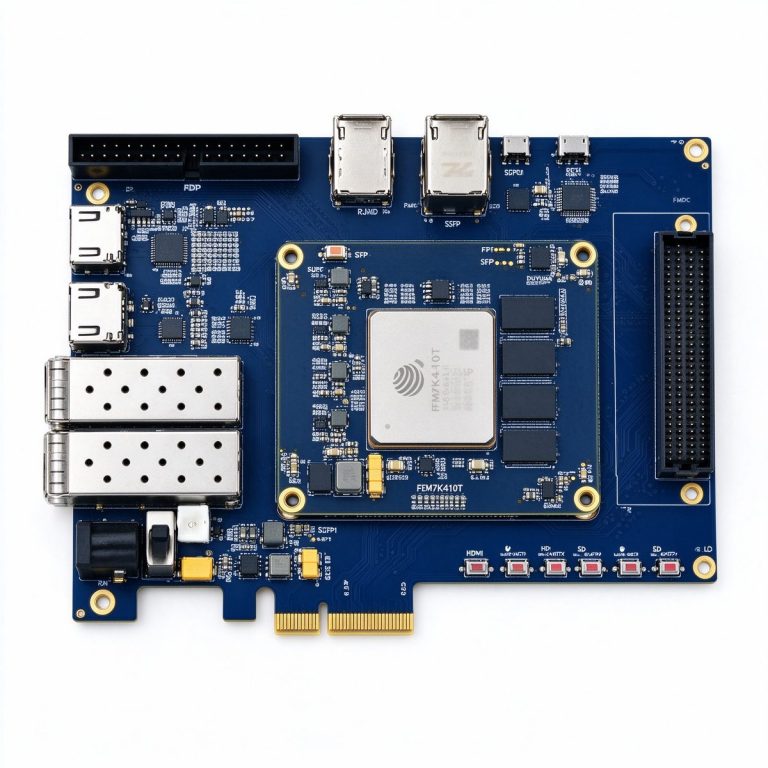
- DUK7410T V1.0 ($1,538): JFM7K410T, 406K LC / 1,540 DSP / 28.6 Mb BRAM — for signal processing, high-speed acquisition and projects needing more compute
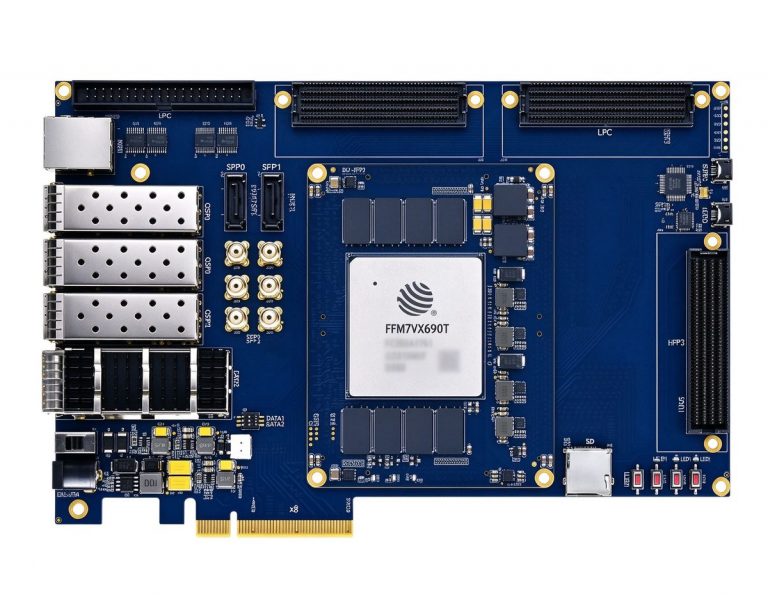
- DUF7690T V1.0 ($3,846): JFM7VX690T, 693K LC / 36 GTH @ 12.5G / FMC×3 / QSFP 40G — for high-end China-based design, radar / software-defined radio / ultra-high-speed acquisition
All three boards share the same optimized baseline: PCIe 2.0 x8 (the Puzhi original only routes x2; we make full use of the PCIe hard block), 4GB DDR3, FMC HPC expansion, HDMI 4K input/output, 2×SFP+ and Gigabit Ethernet, with complete schematics, PCB projects and Vivado examples included. Customers can run their original Xilinx Kintex-7 projects directly on the JFM7 boards for China-migration verification.
China replacement is not about “finding something that runs”; it is about “smoothly moving your already-verified design assets over while guaranteeing performance and supply.” The value of JFM7 lies precisely in being the China FPGA closest to that path — most of your Vivado projects, your HDL code and your PCB do not need to be thrown away.