TSN: How Deterministic Ethernet and Frame Preemption Actually Land on an FPGA
Standard Ethernet’s best-effort delivery is not enough for industrial control: a large file transfer on the same cable can delay a motion-control frame by milliseconds. TSN (Time-Sensitive Networking, IEEE 802.1) adds time synchronization, time-gated scheduling and frame preemption to turn Ethernet into a predictable, calculable network. This article breaks it down into numbers and shows how to land it on FPGA boards.
Why standard Ethernet is “unpredictable” in industrial control
Standard Ethernet is essentially “whoever arrives first sends first”. The problem is not average latency but the uncontrollable worst case:
- On a 1Gbps port, a 1518-byte large frame is being transmitted;
- At the same moment, a 64-byte high-priority motion-control frame arrives at the switch port;
- The switch cannot interrupt the frame in flight, so the control frame queues and waits.
This queuing wait is where jitter comes from. It does not matter in an office network, but in multi-axis motion control, robot joints and servo coordination the control cycle is typically 125µs or shorter; a control frame that arrives a few hundred microseconds late means the axes fall out of sync.
TSN does not change the cable. It overlays a set of deterministic scheduling rules on Ethernet so the worst case becomes designable and calculable.
What TSN actually solves: four standards together
TSN is not one protocol but a set of standards from the IEEE 802.1 working group. The four commonly used blocks:
| Sub-standard | What it solves | Plain meaning |
|---|---|---|
| 802.1AS (gPTP) | Network-wide time sync | All switches and nodes share one clock, within 1µs |
| 802.1Qbv (TAS, time-aware shaper) | Traffic sent on a schedule | Each port’s queues have a “gate schedule”, deciding when real-time and normal traffic go out, to the microsecond |
| 802.1Qbu / 802.3br (frame preemption) | High-priority frames not blocked by large frames | A long frame can be interrupted halfway, yield, then resume |
| 802.1Qat / 802.1Qav | Bandwidth reservation and queue management | Reserve fixed bandwidth for real-time streams so normal traffic cannot burst into it |
Think of TSN as a dedicated bus lane on the cable: first all intersections align their clocks (gPTP), then the bus must use the dedicated lane at scheduled times and other traffic runs off-peak (TAS), and a bus can slip through a gap when a truck blocks the road (preemption).
Three numbers: cutting latency from milliseconds to microseconds
How long a frame occupies a 1Gbps link
First the physical layer. 1Gbps is 10^9 bit per second; transmit time = bits / 10^9.
| Frame type | Bytes | Bits | 1Gbps transmit time |
|---|---|---|---|
| Minimum Ethernet frame | 64 B | 512 bit | 0.512 µs |
| Normal frame | 512 B | 4096 bit | 4.10 µs |
| Standard maximum frame | 1518 B | 12144 bit | 12.14 µs |
| Jumbo frame | 9000 B | 72000 bit | 72.0 µs |
A standard maximum frame occupies the link for about 12.1µs. Without preemption, a high-priority control frame waits up to that full 12.1µs, plus switch forwarding and queuing — jitter can easily reach hundreds of microseconds to milliseconds.
How much blocking preemption removes
802.1Qbu/802.3br splits a long frame at a 64-byte boundary. When a high-priority frame arrives:
- If the in-flight long frame has passed the first 64 bytes (fragment checkpoint), interrupt it immediately;
- Send the high-priority frame fully (worst case 0.512µs);
- Record the breakpoint on the long frame and resume it later.
Compare worst-case blocking:
- No preemption: control frame waits for a whole large frame ≈ 12.14µs;
- With preemption: control frame waits for less than one fragment (≤64B, 0.512µs) plus its own transmit time.
This gap from ~12µs to ~1µs is why TSN can reach microsecond control cycles.
How gPTP time synchronization aligns
The TAS schedule must use one shared time across the network, or each switch opens its own gates at different times. 802.1AS (gPTP) aligns master and slave via link-layer timestamp exchange:
- The grandmaster sends periodic sync messages;
- Each switch hops hardware-timestamps the packet in/out to correct link asymmetry;
- End nodes adjust their local clock from the grandmaster.
In practice gPTP end-to-end offset is typically within ±1µs, which is the prerequisite for TAS schedules at microsecond granularity. Without good sync, all the scheduling is meaningless.
Landing TSN on an FPGA: from MAC to time gating
TSN timestamps and gating demand hardware precision; a CPU plus software stack cannot reach microseconds — that is where FPGA sits. A typical FPGA TSN node chain:
1. PHY: multi-rate 100M/1G/2.5G/5G, supporting frame preemption (802.3br) fragmentation and reassembly;
2. Ethernet MAC: hard or soft MAC, outputting timestamped streams;
3. TSN IP core: gPTP slave clock, TAS time-gated scheduler, preemption/reassembly in FPGA logic;
4. Business logic: motion-control frames, sensor data and normal traffic into separate queues.
The key point: timestamps must be stamped in hardware at the PHY/MAC boundary, not recorded by software after packet receipt — the latter alone costs tens of microseconds. FPGA keeps “packet arrives → timestamp → look up gate table → decide when to send” in one clock domain, which is its core advantage over a general CPU gateway.
Selection: three board tiers for TSN nodes
Different TSN scenarios demand different logic resources and transceiver counts; choose by budget and port count:
| Board | FPGA platform | TSN role | Why |
|---|---|---|---|
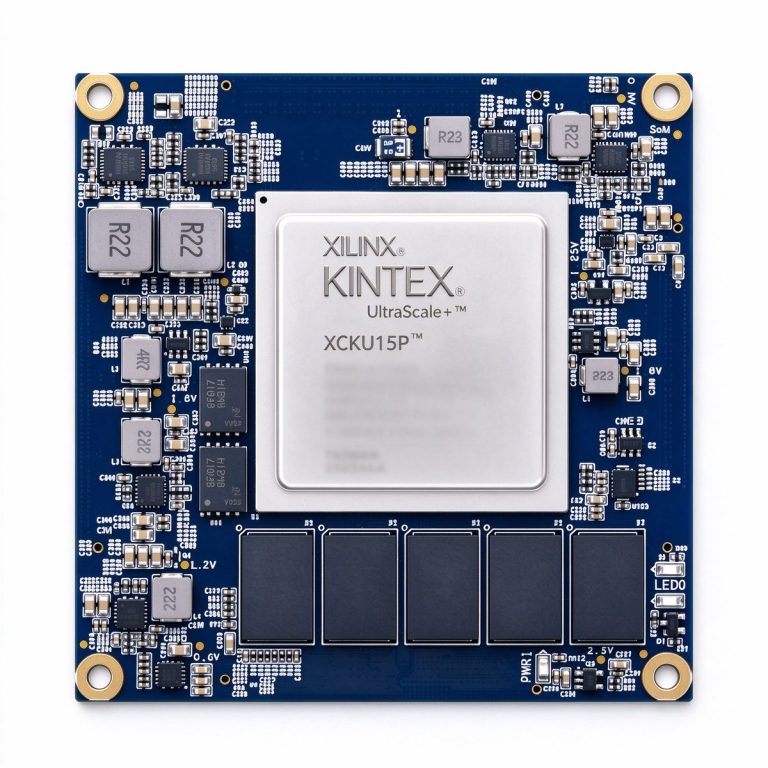
| XCKU15P core board | Kintex UltraScale+ | Multi-port TSN aggregation / edge gateway | Abundant logic, GTH transceivers and hard Tri-Mode MAC; runs gPTP slave + multi-way TAS scheduling + business acceleration together |
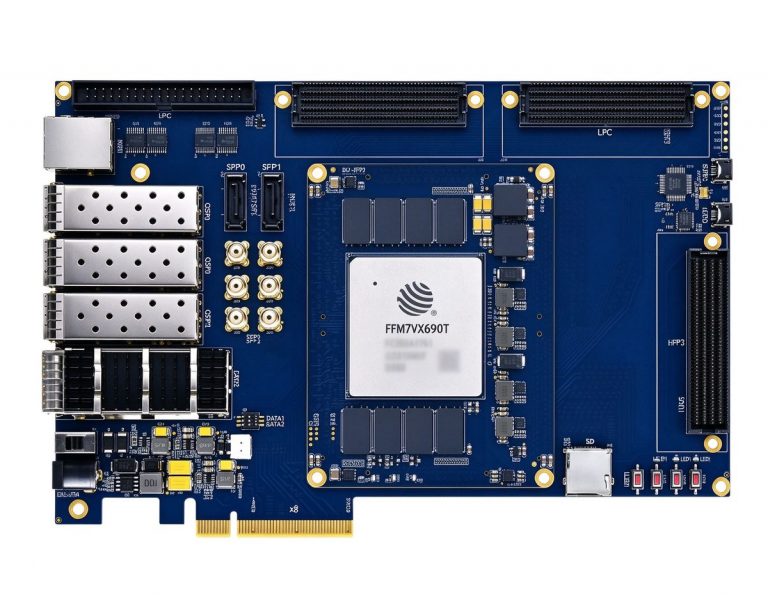
| DUF7690T | FudanMicro JFM7VX690T (pin-compatible with XC7VX690T) | High-reliability / domestic TSN node | Virtex-7 class, industrial temperature, for supply-chain and reliability-sensitive domestic lines |
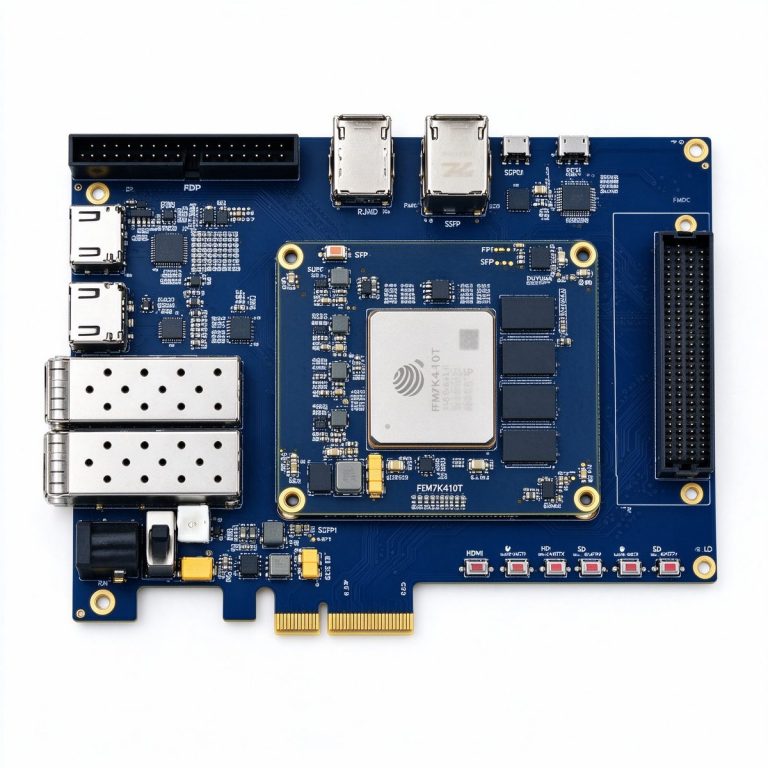
| DUK7410T | FudanMicro JFM7K410T (pin-compatible with XC7K410T) | Single/dual-port TSN endpoint | Kintex-7 class, lower cost; enough for one gPTP slave port plus single TAS, suited to volume endpoints |
A common mix: DUK7410T as field endpoints, DUF7690T as domestic work-cell gateways, XCKU15P as the multi-port TSN aggregation node for the whole line, so ordinary IP/video traffic and real-time control traffic are separated by TSN queues on one cable.
Case: merging one mixed cable onto TSN
A machine originally used two cables: one for PLC and servo real-time control, one for camera images and logs. After the retrofit they merged to one gigabit cable split by TSN:
- Real-time control frames use a dedicated TAS gate, 125µs cycle, about 10% bandwidth reserved;
- Camera bulk traffic uses the normal queue, and preemption guarantees it never blocks the control frame;
- gPTP aligns the 4 servo nodes within 1µs.
Measured after retrofit: worst-case control-frame jitter dropped from about 800µs to under 3µs, cables halved from two to one, and switch ports and wiring cost dropped together.
Determinism is not making the network faster, but turning the “worst case” from unknowable into calculable — that is exactly where FPGA puts time into hardware.
Further reading
- [10G/25G fiber backhaul: building long-range high-bandwidth links](/article/fiber-backhaul-10g-25g/)
- [FMC mezzanine ecosystem: extending boards with dedicated interfaces](/article/fmc-mezzanine-ecosystem/)
- [PCIe bandwidth planning: calculating bandwidth between host and board](/article/pcie-bandwidth-planning/)